Two things nobody tells you about winning bigger clients
If you run a small-to-medium team, you've probably had this thought: how do the big agencies keep winning the work we could do better?
I used to think the answer was effort. Pitch harder. Follow up more. Undercut on price. Be the hungriest team in the room.
It's taken me a few years to work out that none of that is the point. The teams that move upmarket don't get there by trying harder. They get there by being smarter about two things: who they sell to, and how they deliver.
Here's what I mean.
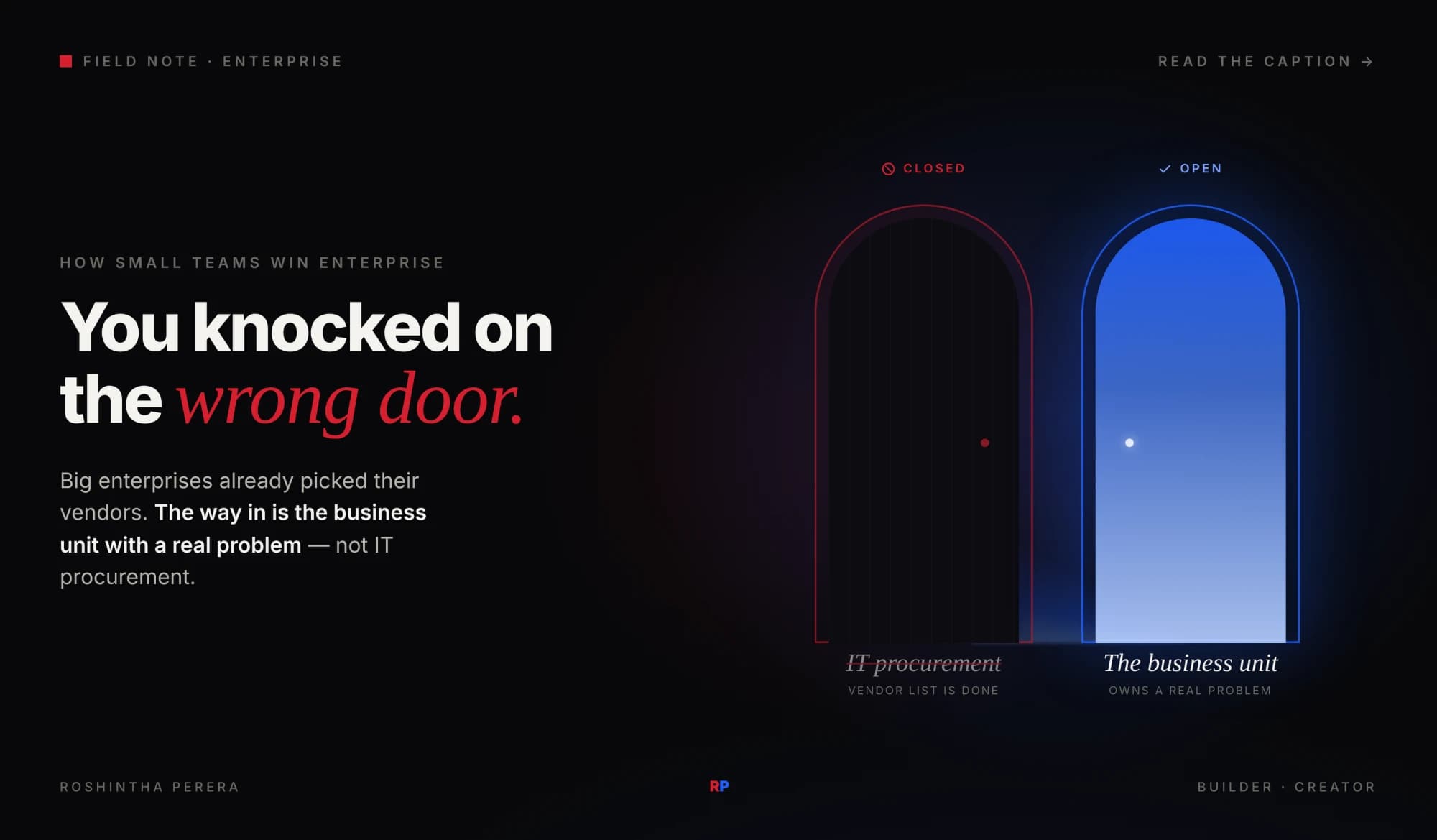
1. You're knocking on the wrong door
Most people trying to sell into a big company aim straight for the IT department. It makes sense on paper. Technology problem, technology buyer.
But here's what actually happens inside a large enterprise: the strategic tech vendors are already chosen. The big consultancies and IT services firms are on the list. That list is done. And a senior team your size is not getting added to it by pitching harder.
So where's the way in?
The business units. Operations. Finance. The people who actually own the problem and live with it every day.
A lot of real product and engineering work doesn't sit with central IT at all. It sits with whoever is drowning in a specific, painful, expensive problem — and has the budget to make it go away. When that person becomes your sponsor, everything changes. Because when the business speaks for you, it lands completely differently than when tech speaks for you.
Let me give you a concrete example.
We worked with an American multi-scale fittings company sending over 1,000 invoices a week. They were paying for a full enterprise document platform — and really only using one small part of it. The rest was shelfware.
So we didn't pitch them a new system. We rebuilt the one part they actually used: an AI invoice automation, connected straight into their CRM. It cost them less than half of a single year of that old subscription.
Here's the thing. Nobody in an IT procurement meeting would have ever asked for that. It wasn't on anyone's roadmap. But the person drowning in invoices every week? They asked for it the moment they realised it was possible.
That's the pattern. Find the person who owns the bottleneck. Ask what's slow, what's manual, what's quietly eating people's hours. Build the smallest thing that fixes it — not a whole new platform. Then let the result speak for you.
Compliance still has to be airtight, of course. GDPR, ISO 27001, the approvals and security reviews before a project even starts. You need all of that to stay in the room. But the room usually opens because someone in the business had a problem and wanted it gone — not because you won a procurement beauty contest.
2. Stop competing on price. Compete on the thing that compounds.
Here's the second lesson, and it took me longer to accept.
The instinct, when you're small and hungry, is to compete on price. Be the cheaper option. Win the deal on the number.
It works — right up until it doesn't. Because price is a one-time event. It gets you in the door, and then it's forgotten. What the client actually remembers, six months in, is how it felt to work with you. Did you deliver fast? Did the work hold up? Did you make their life easier or harder?
Price fades. Delivery compounds.
Picture the two lines on a graph. Price spikes at the start — it's the loudest thing in the room on day one. Then it flattens and fades, because nobody renews a contract out of gratitude for a discount. Delivery starts quieter. But every good handoff, every deadline hit, every problem solved before the client even noticed it — that line keeps climbing. It compounds into trust, into referrals, into the next project.
So if you only ever win on being cheapest, you've built your business on the one thing that doesn't last. Worse, you attract exactly the clients who chose you for your price — and they'll leave the second someone quotes lower.
I'd rather win on how fast and how well we deliver. Every time.
That doesn't mean price doesn't matter. It means price is the cost of entry, not the reason anyone stays. The reason they stay is that working with you got easier, not harder, the longer it went on.
Where the two ideas meet
Here's what connects them.
Winning bigger clients and keeping better clients are the same muscle. You get in by solving a real, specific problem for the person who owns it. You stay in by delivering so well that leaving you becomes the expensive choice.
Neither of those is about being the loudest, the hungriest, or the cheapest. Both are about being the team that actually understands the problem and makes it disappear.
That's the whole game. Find the right door. Then make yourself hard to replace once you're through it.
If you've moved a small-to-medium team upmarket, I'd genuinely like to know: did you get there by changing who you sold to, or by changing how you delivered?